When Will a Super Blood Wolf Moon Happen Again
Don't Miss the Super Blood Wolf Moon Eclipse Tonight! Information technology'southward the Last Until 2021.
Update for 3 a.one thousand. EST, Jan. 21:The total lunar eclipse of 2019 has concluded.Run into our total story hither! See more than photos here!
Original Story: The moon will pass through Earth's shadow this evening in the only total lunar eclipse of 2019 and y'all won't desire to miss it! If y'all do, you'll have to expect two years for the next one. And if you're in North America, you lot'd have to wait even longer, until 2022!
Skywatchers in Northward America will go a celestial treat late Sunday (January. twenty) and early Mon (Jan. 21), when the moon goes into eclipse and turns blood cherry-red. While the weather volition be very cold for many in North America, astronomers say to packet upwardly and cheque out the sight now. That'southward because the adjacent total eclipse won't happen until 2021, and North Americans will accept to wait until 2022 for a claret moon to be visible from their location. Tonight's total lunar eclipse is occurring while the moon is most it's closest signal to Earth for the month, which some phone call a "supermoon." Since January's total moon is besides known as the Wolf Moon, that's led some to christen this evening's lunar event a Super Blood Wolf Moon.
The partial phase of the lunar eclipse begins at 10:34 p.m. EST Sun night (0334 GMT Monday morning) with the full eclipse beginning at 11:41 p.m. EST (0441 GMT Mon morning). Totality lasts for well-nigh an hour, so the moon will leave the partial eclipse phase at i:51 a.one thousand. EST Monday morn (0651 GMT). Webcasts are available at Slooh.com, timeanddate.com and several other sites, equally well equally at Space.com, courtesy of Slooh. [Super Claret Moon Lunar Eclipse of 2019: Consummate Guide]
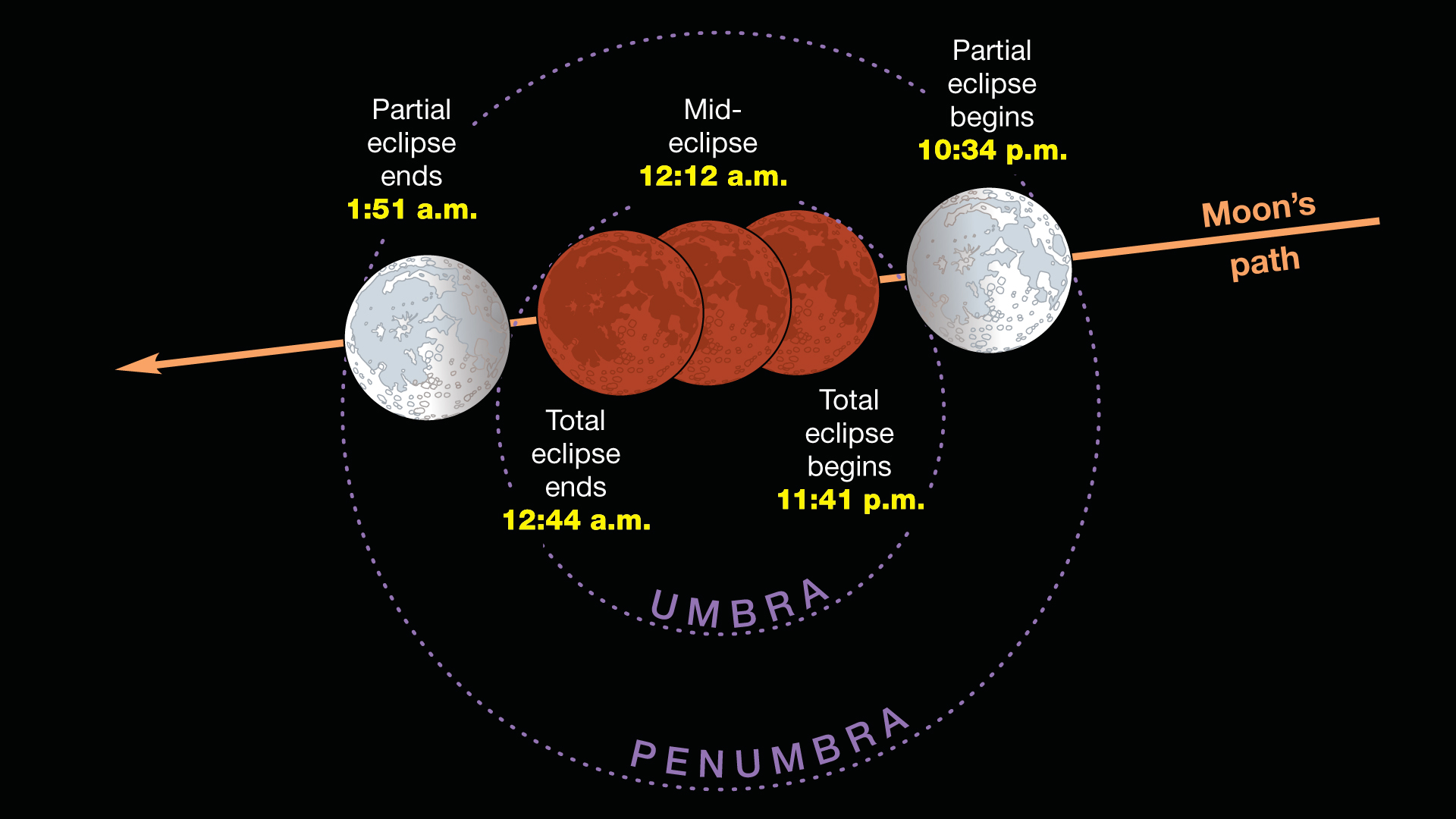
Lunar eclipses happen when the moon passes into the Earth's shadow. During a full eclipse, the moon passes so deep into the shadow that whatsoever light reaching its surface only comes from the edge of Earth, where sunrises and sunsets are taking place. That light falls on to the moon and turns it red, or sometimes appearing as a more than ruddy chocolate-brown depending on how dusty your local temper is (among other factors).
Because of the geometry of Earth, dominicus and moon, sometimes in that location are periods during which no lunar eclipses happen for a long time. This situation happens every 19 years, David Dundee, an astronomer at the Tellus Science Museum in Cartersville, Ga., told Space.com.
"At that place are actually more than than one set of patterns all running concurrently," he wrote in an email. "[Information technology all] has to do with how the orbit of the moon oscillates north and due south. When the orbit passes through the plane of the Globe's orbit, this is a 'node'; this is when an eclipse tin happen if the moon phase is correct." So in other words, the moon won't experience a total eclipse for a while because the orbital nodes of the moon aren't happening at the right time for the full moon to pass through the Earth's shadow.
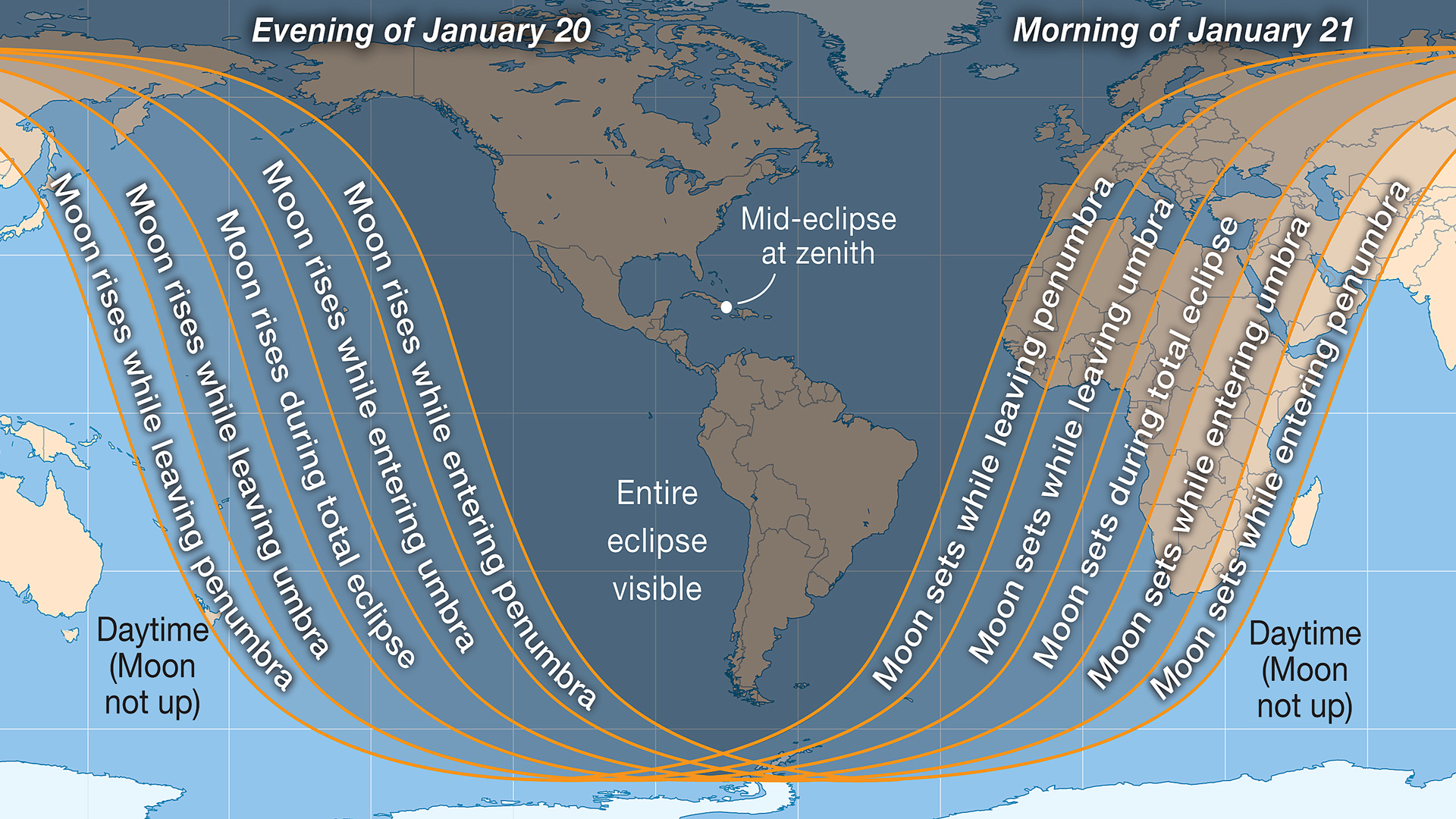
The lord's day likewise goes through a bicycle of lulls for solar eclipses, which occur when the moon passes in front of the sun. However, solar eclipses are much more complicated — and non only because they crave special protection for your eyes. While skywatchers coast to coast in the United States got the chance to see a solar eclipse in 2017, the shadow of the moon is then small that it a total lunar eclipse passes over a band that only stretches 70 to 100 miles (112 to 161 kilometers), Dundee said. Full lunar eclipses, by contrast, are visible over an entire hemisphere of Earth.
Whether you watch this weekend's lunar eclipse past webcast or in person, Dundee has some tips nigh what to expect for.
"Look for the edge of the shadow covering the moon. It volition be fuzzy or ragged," he said. "This is because of the Earth'south atmosphere; [it] will cause the edge of the shadow to be ill divers. Plus every bit the eclipse progresses, y'all can see the shape of the shadow is round, a consequence of living on a circular planet. Finally, the color of the fully eclipsed moon depends on the corporeality of dust in the Earth'southward atmosphere and the cloud cover on other parts of the Earth."
No special equipment is needed for the lunar eclipse — only your own optics and some warm clothing. If yous accept binoculars or a telescope handy, yous might see a footling more detail on the lunar features, just more often than not yous can look more mottled red inside the viewfinder.
Editor's notation: If you snap an amazing photo of the January 2019 total lunar eclipse that you'd similar to share with Infinite.com and our news partners for a possible story or prototype gallery, send comments and images in to: spacephotos@space.com.
Follow u.s. @Spacedotcom and Facebook. Original commodity on Space.com.
Join our Infinite Forums to keep talking infinite on the latest missions, night heaven and more than! And if you have a news tip, correction or comment, let us know at: community@space.com.

Elizabeth Howell, Ph.D., is a contributing writer for Infinite.com since 2012. As a proud Trekkie and Canadian, she tackles topics similar spaceflight, multifariousness, scientific discipline fiction, astronomy and gaming to aid others explore the universe. Elizabeth'due south on-site reporting includes two man spaceflight launches from Kazakhstan, and embedded reporting from a simulated Mars mission in Utah. She holds a Ph.D. and M.Sc. in Space Studies from the University of North Dakota, and a Bachelor of Journalism from Canada's Carleton University. Her latest book, NASA Leadership Moments, is co-written with astronaut Dave Williams. Elizabeth get-go got interested in space afterward watching the movie Apollo 13 in 1996, and even so wants to be an astronaut someday.
Source: https://www.space.com/43062-super-blood-moon-2019-last-until-2021.html
0 Response to "When Will a Super Blood Wolf Moon Happen Again"
Post a Comment