Recursion Here We Go Again Meme
past Kevin Turney
Recursion is not hard: a footstep-by-pace walkthrough of this useful programming technique
I'thou going to say this right off the bat. Practise you lot know the events that happen upon role invocation? No? Then that's where we will start.
Function invocation
When we call a function, an execution context gets placed on the execution stack. Let's break this down some more.
Kickoff, what is a stack?
A stack is a information structure that operates on a "Last In, First Out" basis. An item is "pushed" onto a stack to add to information technology, and an particular is "popped" off the stack to remove it.
Using a stack is a method of ordering certain operations for execution.
Now, back to what is an execution context? An execution context forms upon a function invocation. This context places itself on an execution stack, an order of operations. The detail that is always first in this stack is the global execution context. Next up are whatever part created contexts.
These execution contexts have backdrop, an Activation Object and a "this" binding. The "this" binding is a reference back to this execution context. The Activation Object includes: parameters passed, declared variables, and function declarations.
And so every time nosotros place a new context on the stack, nosotros normally accept everything we demand to execute code.
Why practise I say usually?
With recursion, nosotros are waiting for return values coming from other execution contexts. These other contexts are higher up the stack. When the last item on the stack finishes execution, that context generates a return value. This return value gets passed down as a return value from the recursive case to the next item. That execution context is so popped off the stack.
Recursion
So, what is recursion?
A recursive function is a function that calls itself until a "base status" is true, and execution stops.
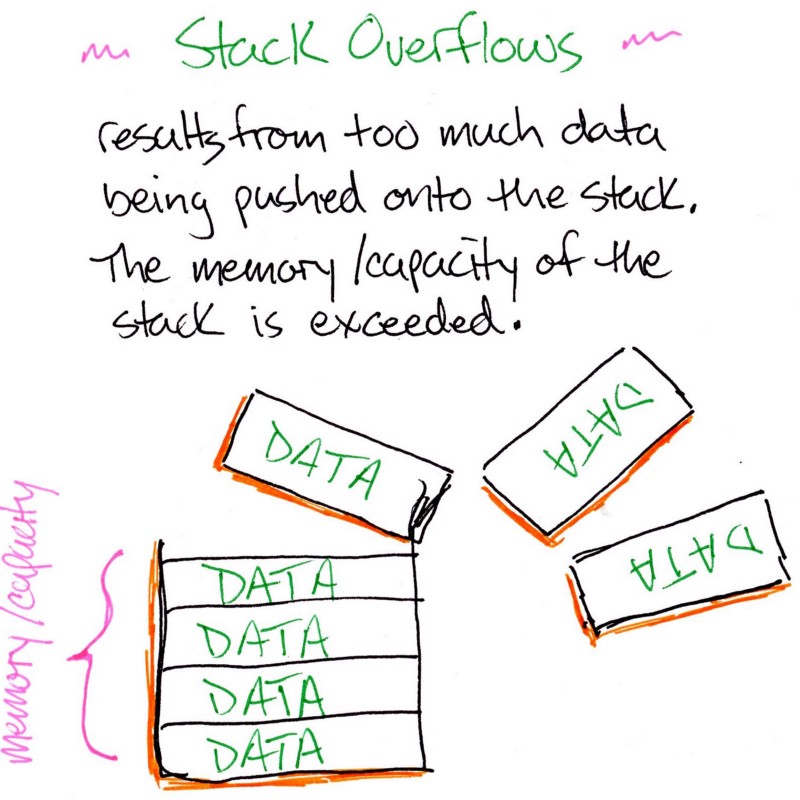
While false, we will keep placing execution contexts on pinnacle of the stack. This may happen until we accept a "stack overflow". A stack overflow is when nosotros run out of memory to hold items in the stack.

In general, a recursive part has at least two parts: a base condition and at least one recursive instance.
Let's wait at a classic case.
Factorial
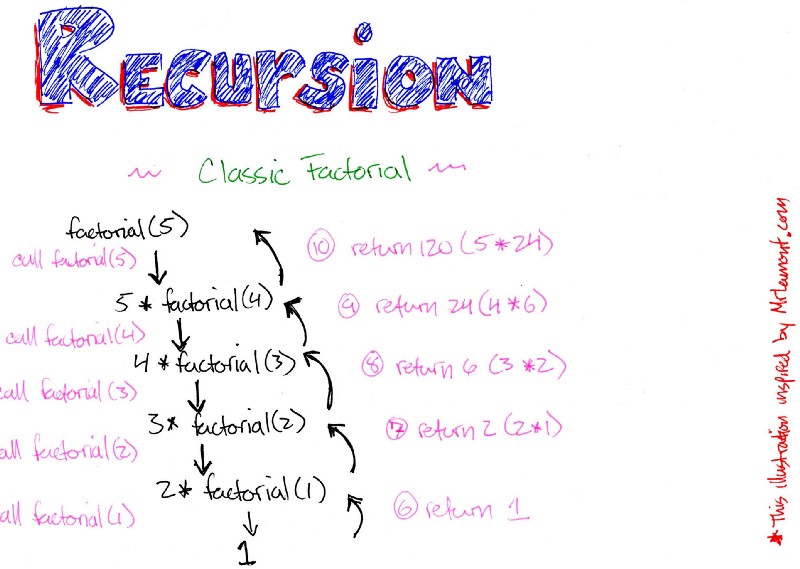
const factorial = function(num) { debugger; if (num === 0 || num === 1) { return ane } else { render num * factorial(num - 1) }} factorial(5) Here we are trying to discover five! (five factorial). The factorial part is defined as the production of all positive integers less than or equal to its argument.
The first condition states: "if the parameter passed equals 0 or i, we will get out and render i".
Next, the recursive case states:
"If the parameter is non 0 or ane, then we will pass value of num times the return value of calling this role again with num-1 as its argument".
And then if we call factorial(0), the function returns 1 and never hits the recursive case.
The same holds for factorial(1).
We can run into what is happening if we insert a debugger statement into the code and use devtools to footstep though it and watch the call stack.
- The execution stack places
factorial()with v as the argument passed. The base instance is false, so enter the recursive condition. - The execution stack places
factorial()a second time withnum-ane= iv every bit argument. Base case is false, enter recursive condition. - The execution stack places
factorial()a third time withnum-1(4–1) = 3 as statement. Base case is imitation, enter recursive condition. - The execution stack places
factorial()a 4th time withnum-1(3–1) = 2 as argument. Base case is false, enter recursive status. - The execution stack places
factorial()a fifth time withnum-ane(2–i) = 1 as argument. Now the base case is true, so return 1.
At this signal, we take decreased the argument past one on each function call until nosotros reach a condition to return ane.
half dozen. From here the last execution context completes, num === 1, so that function returns 1.
vii. Side by side num === 2, so the return value is two. (1×two).
8. Next num === 3, sothe return value is six, (two×three).
And then far we have 1×2×3.
9. Next, num === iv, (4×6). 24 is the return value to the next context.
10. Finally, num === v, (5×24) and we have 120 as the concluding value.
Recursion is pretty neat, right?
We could accept done the same matter with a for or a while loop. Only using recursion yields an elegant solution that is more readable.
This is why we use recursive solutions.
Many times, a problem broken downwardly into smaller parts is more efficient. Dividing a problem into smaller parts aids in acquisition information technology. Hence, recursion is a divide-and-conquer approach to solving problems.
- Sub-problems are easier to solve than the original problem
- Solutions to sub-problems are combined to solve the original trouble
"Dissever-and-conquer" is most often used to traverse or search data structures such as binary search trees, graphs, and heaps. It as well works for many sorting algorithms, like quicksort and heapsort.
Permit'due south work through the following examples. Use devtools to get a conceptual grasp of what's happening where and when. Call up to use debugger statements and stride though each process.
Fibonacci
const fibonacci = part(num) { if (num <= 1) { return num } else { return fibonacci(num - i) + fibonacci(num - 2) }}fibonacci(five); Recursive arrays
function flatten(arr) { var result = [] arr.forEach(function(element) { if (!Array.isArray(element)) { result.push(element) } else { upshot = effect.concat(flatten(element)) } }) return outcome} flatten([one, [2], [3, [[4]]]]); Reversing a string
function reverse(str) { if (str.length === 0) return '' render str[str.length - ane] + reverse(str.substr(0, str.length - 1))} contrary('abcdefg'); Quicksort
function quickSort(arr, lo, hello) { if (lo === undefined) lo = 0 if (hello === undefined) hi = arr.length - 1 if (lo < hi) { // partition the array var p = partition(arr, lo, howdy) console.log('sectionalization from, ' + lo + ' to ' + hi + '=> partition: ' + p) // sort subarrays quickSort(arr, lo, p - i) quickSort(arr, p + i, how-do-you-do) } // for initial call, return a sorted assortment if (howdy - lo === arr.length - 1) return arr} part partition(arr, lo, hi) { // choose terminal element as pivot var pivot = arr[hi] // keep track of index to put pivot at var pivotLocation = lo // loop through subarray and if element <= pivot, place element before pivot for (var i = lo; i < hullo; i++) { if (arr[i] <= pivot) { swap(arr, pivotLocation, i) pivotLocation++ } } bandy(arr, pivotLocation, hi) return pivotLocation} function bandy(arr, index1, index2) { if (index1 === index2) return var temp = arr[index1] arr[index1] = arr[index2] arr[index2] = temp console.log('swapped' + arr[index1], arr[index2], +' in ', arr) return arr} quickSort([1, iv, 3, 56, nine, eight, 7, v]) Practicing recursive techniques is important. For nested data structures like trees, graphs, and heaps, recursion is invaluable.
In a future article, I will talk over tail-phone call optimization and memoization techniques equally they chronicle to recursion. Thank you for reading!
Farther resources
Wikipedia
Software Engineering
Another good article
Grand.I.T. open courseware
Acquire to code for free. freeCodeCamp's open source curriculum has helped more than than twoscore,000 people get jobs as developers. Become started
Source: https://www.freecodecamp.org/news/recursion-is-not-hard-858a48830d83/
0 Response to "Recursion Here We Go Again Meme"
Post a Comment