Hp Lovecraft Book Cover Hp Lovecraft Book Cover Art Fantasy Art
- 🔀 This is an article near the real world person. For the ones who appear inside pieces of fiction, see Howard Phillips Lovecraft (fictional)
| " | I am Providence, & Providence is myself—together, indissolubly as one, we stand up thro' the ages; a fixt monument ready aeternally in the shadow of Durfee's ice-clad height! | „ | |
| ~ HPL , Selected Letters 2.218 |

 Howard Phillips Lovecraft (August 20, 1890 – March 15, 1937), of Providence, Rhode Island, was an American author of fantasy, horror, and science fiction.
Lovecraft's major inspiration and invention was cosmic horror, the basic premise of which is that the true workings of the universe are beyond human comprehension and that humanity's place in the creation is terrifyingly insignificant. A fundamental feature of many of his stories is the being of powerful, extraterrestrial or supernatural entities that influence or threaten the human world in subtle ways, and whose mere perception past human observers often drives the latter to madness.
Lovecraft has get a cult figure for his Cthulhu Mythos, a series of loosely interconnected fictions featuring a pantheon of human-invalidating entities, equally well as the famed Necronomicon, a grimoire of magical rites and forbidden lore. His works were deeply pessimistic, fabricating a mythos that challenged the values of the Enlightenment, Romanticism, and Christianity.
Although Lovecraft's readership was limited during his life, his reputation has grown over the decades, and he is at present commonly regarded as ane of the about influential horror writers of the 20th Century, exerting widespread and indirect influence, and frequently compared to Edgar Allan Poe in the tone of his writing style.
He is former suspected of having used the pseudonym Paul H. Lovering, "writer of When The World Grew Common cold and The Colour Out of Space [sic], etc.",[1] when publishing the story "The Inevitable Conflict?". However a give-and-take analysis of this story showed that it significantly deviates from Lovecraft's known corpus of text.[2]
Contents
- ane Biography
- 1.1 Early Life
- ii Influence
- iii Legacy
- 4 Themes
- 4.i Forbidden noesis
- 4.2 Nonhuman influences on humanity
- 4.3 Atavistic guilt
- 4.iv Inability to escape fate
- iv.5 Civilization under threat
- 4.6 Racism
- four.seven Gender
- four.eight Risks of a Scientific Era
- 5 Influences
- half dozen General Influence
- seven Survey of the piece of work
- 8 Letters
- 9 Gallery
- x References
Biography
Early Life
Lovecraft was born on the 20th of August 1890, at 9:00 a.m. in his family dwelling house at 194 (now 454) Angell Street in Providence, Rhode Island. The business firm would be torn downward in 1961. He was the only kid of Winfield Scott Lovecraft, a traveling salesman of jewelry and precious metals, and Sarah Susan Phillips Lovecraft, a woman who could trace her beginnings in America dorsum to the Massachusetts Bay Colony in 1630. His parents married, the get-go spousal relationship for both, when they were in their thirties. This was unusually belatedly in life given the time menses. In 1893, when Lovecraft was three, his male parent became acutely psychotic in a Chicago hotel room while on a business trip. He was brought dorsum to Providence and placed in Butler Hospital where he remained until his death in 1898. Lovecraft was informed that his father was comatose during this period but it is now nearly certain that Winfield Scott Lovecraft died from third syphilis.
Indeed his earliest surviving literary piece of work, "The Poem of Ulysses" (1897), is a paraphrase of the Odyssey in 88 lines of internally rhyming verse. Only Lovecraft had by this time already discovered weird fiction, and his first story, the non-extant "The Noble Eavesdropper," may date to as early on as 1896.
Lovecraft thereafter was raised past his mother, his two aunts (Lillian Delora Phillips and Annie Emeline Phillips), and his granddad, Whipple Van Buren Phillips. All resided together in the family home. Lovecraft was a kid prodigy, reciting poetry at historic period two and writing complete poems past 6. His granddad encouraged his reading, providing him with classics such as The Arabian Nights, Bulfinch's Age of Legend, and children's versions of The Iliad and The Odyssey. His grandfather also stirred young Howard's involvement in the weird by telling him his ain original tales of Gothic horror. His mother, on the other hand, worried that these stories would upset him.
Lovecraft was frequently ill as a child, both physically and psychologically. Due to his sickly condition and his undisciplined, argumentative nature, he barely attended school until he was eight at the Slater Avenue School but was withdrawn after a year. He read voraciously during this period and became especially enamored of chemical science and astronomy. He produced several hectographed publications with a limited circulation beginning in 1899 with The Scientific Gazette. Four years later he returned to public school at Hope Street High School.
Whipple Van Buren Phillips' death in 1904 profoundly affected Lovecraft's life. Mismanagement of his grandpa's estate left his family in such a poor fiscal situation they were forced to move into much smaller accommodations at 598 (now a duplex at 598-600) Angell Street. Lovecraft was so securely afflicted by the loss of his home and birthplace he contemplated suicide for a time. In 1908, prior to his high school graduation, he suffered a nervous breakdown and consequently never received his high school diploma. S. T. Joshi suggests in his biography of Lovecraft that a master cause for this breakdown was his difficulty in higher mathematics, a bailiwick he needed to master to become a professional person astronomer. This failure to consummate his pedagogy (he wished to report at Dark-brown Academy) was a source of disappointment and shame even late into his life.
Lovecraft wrote some fiction as a youth but from 1908 until 1913 his output was primarily poesy he wrote while living a hermit's existence and having about no contact with anyone but his mother. This changed when he wrote a letter to The Argosy, a lurid magazine, lament about the insipidness of the love stories of one of the publication's popular writers. The ensuing argue in the magazine's letters column caught the eye of Edward F. Daas, President of the UAPA, who invited Lovecraft to join in 1914. The UAPA reinvigorated Lovecraft and incited him to contribute many poems and essays. In 1917, at the prodding of correspondents, he returned to fiction with more polished stories such every bit "The Tomb" and "Dagon". The latter was his first professionally published work, appearing in Weird Tales in 1923. Effectually this time he began to build up a huge network of correspondents. His lengthy and frequent missives would make him one of the great letter writers of the century. Amid his correspondents were Robert Bloch, Clark Ashton Smith and Robert E. Howard (author of the Conan the Barbarian serial).
In 1919, afterward suffering from hysteria and depression for a long menstruation of fourth dimension, Lovecraft's mother had a nervous breakup and was committed to Butler Hospital like her husband before her. Notwithstanding, she wrote frequent letters to Lovecraft, and they remained very close until her death on May 21, 1921, the effect of complications from a gall float surgery. Lovecraft was devastated by the loss.
A few weeks after the death of his mother, Lovecraft attended an amateur announcer convention in Boston where he met Sonia Greene. Born in 1883, she was of Ukrainian Jewish ancestry and 7 years older than Lovecraft. They married in 1924, and the couple moved to the civic of Brooklyn in New York City. Lovecraft's aunts may have been unhappy with this arrangement, as they were non addicted of Lovecraft being married to a tradeswoman (Greene owned a hat store). Initially Lovecraft was enthralled by New York simply soon the couple was facing financial difficulties. Greene lost her hat store and suffered poor health. Lovecraft could not find work to support them both and so his married woman moved to Cleveland for employment. Lovecraft lived past himself in the Red Hook neighborhood of Brooklyn and came to intensely dislike New York life[3].
A few years later he and Greene, still living separately, agreed to an amicable divorce, which was never fully completed. He returned to Providence to live with his aunts during their remaining years. Due to the unhappiness of their spousal relationship, some biographers have speculated that Lovecraft could have been asexual, though Greene is ofttimes quoted equally referring to him as "an adequately fantabulous lover".
Back in Providence, Lovecraft lived in a "spacious brown Victorian wooden house" at x Barnes Street (the address given as the abode of Dr. Willett in The Case of Charles Dexter Ward) until 1933. The period after his return to Providence—the last decade of his life—was Lovecraft's nigh prolific. During this fourth dimension menstruum he produced almost all of his best-known short stories for the leading lurid publications of the day (primarily Weird Tales) every bit well as longer efforts like The Instance of Charles Dexter Ward and At the Mountains of Madness. He frequently revised work for other authors and did a large amount of ghost-writing, including "The Mound", "Winged Death", and "The Diary of Alonzo Typer".
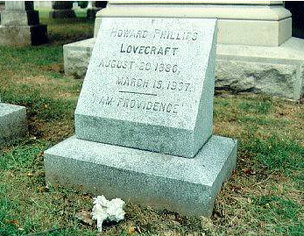
Despite his best writing efforts, even so, he grew ever poorer. He was forced to motion to smaller and meaner lodgings with his surviving aunt. He was also deeply afflicted by Robert E. Howard'south suicide. In 1936 he was diagnosed with cancer of the intestine and he also suffered from malnutrition. He lived in constant hurting until his death on March 15, 1937 in Providence. Lovecraft was listed along with his parents on the Phillips family monument. That was not plenty for his fans, then in 1977 a group of individuals raised the money to purchase him a headstone of his own, on which they had inscribed Lovecraft's name, the dates of his birth and decease and the phrase, "I AM PROVIDENCE," a line from one of his personal letters. Lovecraft's grave in Swan Point Cemetery in Providence is occasionally marked with graffiti quoting his famous phrase from "The Call of Cthulhu" (originally from "The Nameless City"):
| " | That is not dead which can eternal lie, And with strange aeons even decease may die. | „ |
Influence
H. P. Lovecraft'due south name is synonymous with horror fiction; his writing, particularly the "Cthulhu Mythos", has influenced fiction authors worldwide, and Lovecraftian elements may be found in novels, movies, music, comic books and cartoons. For instance, the insane villains of Gotham City in the Batman stories are incarcerated in Arkham Aviary - Arkham being an invention of Lovecraft'south. Many modernistic horror writers — such as Stephen Rex, Bentley Little, Joe R. Lansdale, to proper name just a few — accept cited Lovecraft every bit one of their chief influences.
Lovecraft himself, though, was relatively unknown during his own time. While his stories might have made it into the pages of prominent pulp magazines such as Weird Tales (ofttimes eliciting messages of outrage from regular readers of the magazines), not many people knew his name. He did correspond regularly with other contemporary writers such every bit Clark Ashton Smith and August Derleth, people who became good friends of his, fifty-fifty if they never met in person. This grouping of correspondents became known every bit the "Lovecraft Circle", since they all freely borrowed elements of Lovecraft'south stories — the mysterious books with agonizing names, the pantheon of ancient conflicting gods such every bit Cthulhu and Azathoth, and eldritch places such as Miskatonic and Arkham — for employ in their own (with Lovecraft's blessing and encouragement). It's been suggested that it was the efforts of the Lovecraft Circle — peculiarly August Derleth — that prevented Lovecraft's name and fiction from disappearing completely into obscurity.
In 2017, Lovecraft was inducted into the Science Fiction and Fantasy Hall of Fame at the Museum of Pop Culture in Seattle.
Legacy
Afterward Lovecraft's expiry, the Lovecraft Circumvolve carried on. Baronial Derleth was probably the most prolific of these writers, and added to and expanded on Lovecraft's vision. Derleth'south contributions accept been controversial, to say the least; while Lovecraft never considered his pantheon of alien gods more than a mere plot device, Derleth created an entire cosmology, complete with a state of war between the "Elderberry Gods" (such as Cthulhu and his ilk) and the "Outer Gods," and went on to acquaintance different gods with the traditional four elements. Non every fan of Lovecraft and Lovecraftian horror has approved of these additions, since they seem to contradict Lovecraft's own vision of a universe without society or programme, with beings that weren't so much malevolent as they were just uninterested in the goings on of humanity. Would Lovecraft have approved of Derleth'due south expansions? It has been said that Lovecraft was a expert sport most this sort of thing, so he probably would take welcomed Derleth's own have, but he certainly wouldn't take taken it on himself. If there can exist said to be a "Lovecraft Circle", then Derleth'southward version would be an interesting have on the circle, only non part of the circle itself.
Lovecraft'south fiction has been grouped into three categories by some critics. While Lovecraft did not refer to these categories himself, he did once write, "In that location are my 'Poe' pieces and my 'Dunsany pieces' — but alas — where are my Lovecraft pieces?"
- Macabre stories (approximately 1905–1920)
- Dream Cycle stories (approximately 1920–1927)
- Cthulhu Mythos / Lovecraft Mythos stories (approximately 1925–1935)
Some critics see little divergence between the Dream Bicycle and the Mythos, often pointing to the recurring Necronomicon and subsequent "gods". A oft given explanation is that the Dream Cycle belongs more than to the genre of fantasy, while the Mythos is scientific discipline fiction. As well, much of the supernatural elements in the Dream Cycle takes place in its own sphere or mythological dimension separated from our ain level of existence. The Mythos on the other hand, is placed within the aforementioned reality and creation as the humans live in.
Much of Lovecraft's work was direct inspired by his nightmares, and it is perhaps this directly insight into the unconscious and its symbolism that helps to account for their continuing resonance and popularity. All these interests naturally led to his deep affection for the works of Edgar Allan Poe, who heavily influenced his earliest macabre stories and writing style known for its creepy temper and lurking fears. Lovecraft's discovery of the stories of Lord Dunsany with their gallery of mighty gods existing in dreamlike outer realms, moved his writing in a new direction, resulting in a series of imitative fantasies in a "Dreamlands" setting.
Another inspiration came from a totally different kind of source; the scientific progresses at the time in such wide areas as biological science, astronomy, geology and physics, all contributed to make the homo race seem even more insignificant, powerless and doomed in a materialistic and mechanical universe, and was a major contributor to the ideas that later would be known as cosmicism, and which gave farther back up to his atheism.
Considering of his love for his own heritage and because of the USA'due south relatively young age as a nation and therefore the demand to create locations that would still give the feeling of something old and at the same fourth dimension western, Lovecraft as well added elements such as fictional New England towns and locations where the stories took place.
It was probably the influence of Arthur Machen, with his carefully constructed tales concerning the survival of ancient evil into modern times in an otherwise realistic world and his mystic beliefs in hidden mysteries which lay behind reality, that added the last ingredient and finally helped inspire Lovecraft to find his own phonation from 1923 onwards.
This took on a nighttime tone with the creation of what is today often called the Cthulhu Mythos, a pantheon of alien actress-dimensional deities and horrors which predate humanity, and which are hinted at in aeon-old myths and legends. The term "Cthulhu Mythos" was coined by Lovecraft's correspondent and fellow writer, August Derleth, after Lovecraft's death; Lovecraft jocularly referred to his artificial mythology as "Yog-Sothothery"[2].
His stories created 1 of the most influential plot devices in all of horror: the Necronomicon, the secret grimoire written by the mad Arab Abdul Alhazred. The resonance and strength of the Mythos concept have led some to incorrectly conclude that Lovecraft had based it on pre-existing myths or occult beliefs. Fake editions of the Necronomicon accept besides been published over the years.
His prose is somewhat antiquarian. Often he employed primitive vocabulary or spelling which had already by his fourth dimension been replaced by contemporary coinages; examples including electric torch (flashlight), Esquimau, and Comanchian. He was given to heavy utilise of an esoteric lexicon including such words as "eldritch," "rugose," "noisome," "squamous," "ichor," and "cyclopean," and of attempts to transcribe dialect voice communication which have been criticized as clumsy, imprecise, and cavalier. His works also featured British English (he was an admitted Anglophile), and he sometimes fabricated utilise of anachronistic spellings, such equally "compleat/consummate," "lanthorn/lantern," and "phantasy/fantasy" (the latter also actualization equally "phantastic" and "phantabulous").
Lovecraft was a prolific letter writer. During his lifetime he wrote thousands of these letters, still the exact number of letters he wrote is still hotly debated. An estimate of 100,000 seems to be the most likely effigy, arrived at by L. Sprague de Military camp. Lovecraft inscribed multiple pages to his group of correspondents in modest longhand. He sometimes dated his letters 200 years earlier the current date, which would have put the writing back in U.Southward. colonial times, before the American Revolution that offended his Anglophilia. He explained that he thought that the 18th and 20th centuries were the "best"; the former being a period of noble grace, and the latter a century of science.
Themes
Forbidden knowledge
| " | The well-nigh merciful thing in the world, I think, is the disability of the human heed to correlate all its contents... some twenty-four hour period the piecing together of dissociated noesis will open up such terrifying vistas of reality, and of our frightful position therein, that we shall either go mad from the revelation or flee from the light into the peace and prophylactic of a new Dark Age. | „ | |
| ~ HPL , "The Call of Cthulhu" |
Lovecraft's protagonists are nevertheless ever driven to this "piecing together," delving into aspects of the universe which humanity has non - or should not - tried to understand. When such vistas are opened, the listen of the protagonist-investigator is oft destroyed. Those who really meet "living" manifestations of the incomprehensible are particularly likely to get mad.
Those characters who attempt to make use of such noesis are almost invariably doomed. Sometimes their work attracts the attention of malevolent beings; sometimes, in the spirit of Frankenstein, they are destroyed by monsters of their own cosmos.
Nonhuman influences on humanity
The beings of Lovecraft'due south mythos often accept human (or mostly man) servants; Cthulhu, for instance, is worshipped under diverse names by cults amid both the Eskimos of Greenland and voodoo circles of Louisiana, and in many other parts of the globe. Also, sure locales or groups of people owe their heritage or are influenced past nonhuman forces; Innsmouth, a boondocks whose population has a history of interbreeding with Deep Ones and worshipping Dagon, is an example.
These worshippers served a useful narrative purpose for Lovecraft. Many beings of the Mythos are too powerful to be defeated by human opponents, then horrific that direct knowledge of them means insanity for the victim. When dealing with such beings, Lovecraft needed a fashion to provide exposition and build tension without bringing the story to a premature finish. Human being followers gave him a way to reveal information about their "gods" in a diluted class, and also made it possible for his protagonists to win temporary victories. Lovecraft, similar his contemporaries, envisioned "savages" equally closer to the Earth, only in Lovecraft'due south case, this meant, so to speak, closer to Cthulhu.
Atavistic guilt
Another recurring theme in Lovecraft'due south stories is the idea that descendants in a bloodline can never escape the stain of atrocities committed past their forebears. Descendants may be very far removed, both in place and in time (and, indeed, in culpability), from the human action itself, and notwithstanding blood will tell (HPL: "The Rats in the Walls," "The Lurking Fear," "Arthur Jermyn," "The Alchemist," "The Shadow Over Innsmouth", The Instance of Charles Dexter Ward). An example of a offense that Lovecraft manifestly considered heinous enough for this consequence is cannibalism (HPL: "The Pic in the House", "The Rats in the Walls").
In some cases, this atavism manifests physically, with characters showing genetic traits that link them to nonhuman or inhuman ancestors, and thereby to the grotesqueries associated with them.
Inability to escape fate
Often in Lovecraft's works the protagonist is not in control of his own actions, or finds it impossible to change course. Many of his characters would exist complimentary from danger if they simply managed to run away; still, this possibility either never arises or is somehow curtailed by some exterior force, as in "The Colour Out of Space". Ofttimes his characters are discipline to a compulsive influence from powerful malevolent or indifferent beings. As with the inevitability of one's ancestry, eventually even running away, or death itself, provides no safe (The Thing on the Doorstep, The Outsider, The Example of Charles Dexter Ward, etc.). In some cases, this doom is manifest in the entirety of humanity, and no escape is possible (The Shadow Out of Time).
Culture under threat
Lovecraft oft dealt with the idea of civilization struggling against more barbaric, archaic elements. In some stories this struggle is at an private level; many of his protagonists are cultured, highly-educated men who are gradually corrupted by some evil influence.
In such stories, the "curse" is frequently a hereditary ane, either because of interbreeding with not-humans (eastward.g. "Facts Concerning the Late Arthur Jermyn and His Family" (1920), "The Shadow over Innsmouth" (1931)) or through direct magical influence (The Case of Charles Dexter Ward). Concrete and mental degradation ofttimes come together; this theme of 'tainted blood' may represent concerns relating to Lovecraft's ain family unit history, peculiarly the death of his begetter due to what Lovecraft must have suspected to be a syphilitic disorder.
In other tales, an unabridged society is threatened by barbarism. Sometimes the atrocity comes as an external threat, with a civilized race destroyed in war (due east.yard. "Polaris"). Sometimes, an isolated pocket of humanity falls into decadence and atavism of its own accord (e.one thousand. "The Lurking Fear"). Merely nearly often, such stories involve a civilized civilization being gradually undermined by a malevolent underclass influenced by inhuman forces.
Racism
- Main article: Racism in the Works of H.P. Lovecraft
Despite the unique and interesting nature of many of Lovecraft's works, several are marred by a racist streak securely ingrained in the writer'south personality. A mutual dramatic device in Lovecraft'southward work is to acquaintance virtue, intellect, elevated course position, civilisation, and rationality with white Anglo-Saxon ethnicity, which he oft posed in contrast to the decadent, intellectually inferior, uncivilized and irrational, which he associated with people he characterized as being of lower course, impure racial "stock" and/or non European ethnicity and nighttime pare complexion who were often the villains in his writings.
Some of his most hostile racist views can be found in his poetry, particularly in "On the Creation of *******," and "New England Fallen" (both 1912). Lovecraft once took this to an extreme, explicitly characterizing blackness people as sub-human:
| " | When, long ago, the gods created Globe; In Jove's off-white paradigm Human was shaped at birth. The beasts for lesser parts were designed; Still were too remote from humankind. To fill up the gap, and join the residual of Human, Thursday'Olympian host conceiv'd a clever plan. A beast they wrought, in semi-man figure, Filled it with vice, and chosen the thing a ******. | „ | |
| ~ HPL , "On the Cosmos of *******" |
In "The Call of Cthulhu" he writes of a captured group of "mongrel" worshippers of Cthulhu:
| " | the prisoners all proved to be men of a very depression, mixed-blooded, and mentally abnormal blazon. Most were seamen, and a sprinkling of negroes and mulattos, largely West Indians or Brava Portuguese from the Republic of cape verde Islands, gave a colouring of voodooism to the heterogeneous cult. But before many questions were asked information technology became manifest that something far deeper and older than negro fetishism was involved. Degraded and ignorant as they were, the creatures held with suprising consistency to the central idea of their loathsome religion. | „ |
The majority of the horror in The Shadow Over Innsmouth is the mixing of races and cultures in an former New England Town. The residents of Innsmouth not simply worship the Deep 1 gods of Dagon and Mother Hydra but intermarry with the creatures, resulting in hybrids whose features are oftentimes described as repulsive and seem to take no personal interests beyond pond and drinking bootleg liquor. The elderly Zadok Allen, a remnant from before the Deep Ones completely took over the town, seems more horrified past the concept of interbreeding than past his neighbors' habit of human sacrifices. The people outside of Innsmouth recall this is the issue of interracial matches and that the mysterious Innsmouth religion is also the outcome of mixing the beliefs of foreigners with Christianity merely feel this is enough reason to hate them. The town itself is destitute and rotting, as though the hybrids have no want to fight the decay of their home. The Elder Sign, which is used by islander to protect themselves from the Deep Ones, is described as looking like a Swastika.
Lovecraft also expressed racist and ethnocentric behavior in his personal correspondence.[6]
| " | For evolved man -- the apex of organic progress on the Globe -- what branch of reflection is more fitting than that which occupies only his higher and exclusively human faculties? The key savage or ape merely looks about his native woods to find a mate; the exalted Aryan should lift his eyes to the worlds of infinite and consider his relation to infinity!!!! | „ | |
| ~ HPL , Selected Letters 1.61 |
In "Herbert Due west--Reanimator," Lovecraft gives an account of a newly deceased black male. He asserts:
| " | He was a loathsome, gorilla-like affair, with abnormally long arms that I could not assistance calling fore legs, and a face that conjured upwards thoughts of unspeakable Congo secrets and tom-tom poundings nether an eerie moon. The body must have looked even worse in life - just the globe holds many ugly things. | „ | |
| ~ HPL , "Herbert W--Reanimator" |
In "The Horror at Blood-red Hook", i character is described as "an Arab with a hatefully negroid rima oris". In "Medusa'southward Ringlet," ghostwritten by Lovecraft for Zealia Bishop, the story's concluding surprise--after the revelation that the story's villain is a vampiric medusa--is that she:
| " | was faintly, subtly, even so to the optics of genius unmistakably the scion of Zimbabwe'due south nearly primal grovellers.... [T]hough in deceitfully slight proportion, Marceline was a negress. | „ |
In "The Case of Charles Dexter Ward," there is a somewhat more than patronizing description of an African - New English language couple: "The present negro inhabitants were known to him, and he was very courteously shewn about the interior past quondam Asa and his stout wife Hannah." In contrast to their obviously alien landlord: "a small rodent-featured person with a guttural emphasis"
In the brusk story "The Rats in the Walls," one of the narrator/protagonist's nine cats has a name with negative racial connotations:
| " | As I take said, I moved in on July 16, 1923. My household consisted of seven servants and nine cats, of which latter species I am specially addicted. My eldest cat, "N*****-Human," was vii years erstwhile and had come with me from my home in Bolton, Massachusetts ... | „ |
The narrators in "The Street," "Herbert West: Reanimator," "He," "The Call of Cthulhu," "The Shadow Over Innsmouth," "The Horror at Reddish Claw," and many other tales express sentiments which could be considered hostile towards Jews. Lovecraft married a woman of Ukrainian Jewish ancestry, Sonia Greene, who later said she had to repeatedly remind Lovecraft of her groundwork when he made anti-Semitic remarks. "Whenever we found ourselves in the racially mixed crowds which characterize New York," Greene wrote after her divorce from Lovecraft, "Howard would go livid with rage. He seemed almost to lose his listen."[xi]
To some extent, Lovecraft's ideas regarding race reflect attitudes common in his era; racial segregation laws were enforced throughout much of the Us and many states had enacted eugenics laws and prohibitions against "miscegenation" which were also common in not-Roman Cosmic areas of Europe. A popular movement during the 1920s succeeded in drastically restricting clearing to the United States, culminating in the Immigration Human action of 1924, which featured expert testimony to the United States Congress on the threat to American social club from the assimilation of more than "inferior stock" from eastern and southern Europe.
Lovecraft was an avowed Anglophile, and held English culture to be the comparative pinnacle of civilization, with the descendants of the English in America every bit something of a second-course offshoot, and everyone else below them (come across, for example, his verse form "An American to Mother England"). His dearest for English history and culture is often repeated in his work (such as Rex Kuranes' nostalgia for England in "The Dream-Quest of Unknown Kadath").
Lovecraft'due south ideas near eugenics frequently extended to his white characters. He showed greater sympathy for white and culturally European groups. The narrator of "Absurd Air" speaks disparagingly of the poor Hispanics of his neighborhood, only respects the wealthy and aristocratic Spaniard Dr. Muñoz, for his Celtiberian origins, and considering he is "a homo of birth, cultivation, and bigotry." The degenerate descendants of Dutch immigrants in the Catskill Mountains, "who stand for exactly to the decadent element of white trash in the South" ("Across the Wall of Sleep", 1919), are mutual targets. In "The Temple," Lovecraft'south narrator is a highly unsympathetic effigy: a World State of war I U-gunkhole helm whose organized religion in his "iron German will" and the superiority of the Fatherland atomic number 82 him to car-gun survivors in lifeboats and, later, kill his own crew, while blinding him to the curse he has brought upon himself. Yet, according to Lovecraft: A Biography, by Fifty. Sprague de Army camp, Lovecraft was horrified by reports of anti-Semitic violence in Germany (prior to World State of war 2, which Lovecraft did not live to encounter), suggesting that Lovecraft was opposed to violent extermination of those he regarded as "inferiors".
Lovecraft's racism has been a continued focus of scholarly and interpretive interest. S.T. Joshi, one of the foremost Lovecraft scholars, notes that "There is no denying the reality of Lovecraft'southward racism, nor can it merely be passed off as "typical of his time," for information technology appears that Lovecraft expressed his views more than pronouncedly (although usually not for publication) than many others of his era. Information technology is besides foolish to deny that racism enters into his fiction."[3] In his volume "H.P. Lovecraft: Against The Globe, Against Life," Michel Houellebecq argues that "racial hatred" provided the emotional force and inspiration for much of Lovecraft's greatest works.
Lovecraft racist animosity is a corollary of his nihilistic notion of biological determinism: At the Mountains of Madness, in which explorers notice evidence of a completely alien race (the Elder Things) who created man beings through bioengineering but who were eventually destroyed by their brutish shoggoth slaves. Even after several members of the party are killed by revived Elder Things, Lovecraft's narrator expresses sympathy for them: "They were the men of another historic period and another order of being... what had they done that we would non accept done in their identify? God, what intelligence and persistence! What a facing of the incredible... Radiates, vegetables, monstrosities, star spawn — whatever they had been, they were men!"
These lines of idea in Lovecraft's worldview -- racism and romantic reactionary defense force of cultural social club in the face of the degenerative modern earth -- have led some scholars to run into a special affinity to the aristocratic, anti-modernism of Traditionalist Julius Evola:
| " | Certainly "The Dream-Quest of Unknown Kadath" with its grandiose portrayal of the onyx city respires the cool and elegant spirit of Tradition, arraigned against which in several stories is the sink of decadence, Innsmouth, an inbred population fabricated up of the offspring of lustful mariners and sea monsters, the negative forcefulness of counter-Tradition. The eternal struggle between the Uranian power of light and the telluric forces of chaos is reflected in Lovecraft'due south work | „ |
Some have interpreted Lovecraft's racial attitude equally being more cultural than brutally biological: Lovecraft showed sympathy to others who were pacifically assimilated into Western civilisation, to the extent of even marrying a Jewish woman whom he viewed as "well assimilated".
Gender
Women in Lovecraft's fiction are rare, and sympathetic women nearly not-existent; the few leading female characters in his stories — like Asenath Waite (though actually an evil male wizard who has taken over an innocent girl's body) in "The Thing on the Doorstep" and Lavinia Whateley in "The Dunwich Horror" — are invariably servants of sinister forces. Romance is likewise almost absent from his stories; where he touches on love, it is usually a platonic love (due east.g. "The Tree"). His characters alive in a world where sexuality is negatively connotated — if it is productive at all, it gives birth to less-than-man beings ("The Dunwich Horror" and "The Shadow Over Innsmouth").
In this context, it might exist helpful to draw attending to the scale of Lovecraft's horror, which has often been described by critics every bit "cosmic horror." Operating on a one thousand, cosmic scale as his stories are, they assign humanity a pocket-size, insignificant function. Consequently, it is not female person sexuality to which the stories categorically deny a vital and positive role — rather, it is human sexuality in general. Too, Lovecraft states in a private alphabetic character (to one of the several female intellectuals he befriended) that discrimination confronting women is an "oriental" superstition from which "aryans" ought to free themselves: axiomatic racism bated, the alphabetic character seems to preclude at to the lowest degree witting misogyny (as does, indeed, his individual life otherwise).
Risks of a Scientific Era
At the turn of the 20th century, man'south increased reliance upon science was both opening new worlds and solidifying the manners past which he could understand them. Lovecraft portrays this potential for a growing gap of homo's understanding of the universe as a potential for horror. Nearly notably in "The Color Out of Space," the disability of science to comprehend a meteorite leads to horror.
In a letter of the alphabet to James F. Morton in 1923, Lovecraft specifically points to Einstein'south theory on relativity as throwing the earth into chaos and making the cosmos a jest. And in a 1929 letter to Woodburn Harris, he speculates that technological comforts risk the collapse of science. Indeed, at a time when men viewed scientific discipline as limitless and powerful, Lovecraft imagined alternative potential and fearful outcomes.
Influences
Lovecraft was influenced past such authors equally Robert W. Chambers (The Male monarch in Yellow) (of whom H. P. Lovecraft wrote in a letter to Clark Ashton Smith: "Chambers is similar Rupert Hughes and a few other fallen Titans - equipped with the right brains and teaching just wholly out of the addiction of using them"), Arthur Machen (The Great God Pan), Lord Dunsany, (The Gods of Pegana and other Dunsany works), Edgar Allan Poe, A. Merritt (The Moon Pool, later on a cracking liking and adoration of the original of The Metal Monster) and Lovecraft'due south friends Robert E. Howard and Clark Ashton Smith.
He too cited Algernon Blackwood every bit an influence, quoting "Works The Centaur" in the caput paragraph of The Phone call of Cthulhu.
Full general Influence
Beyond direct adaptation, Lovecraft and his stories accept had a profound impact on popular culture and have been praised by many modern writers. Some influence was direct, as he was a friend, inspiration, and correspondent to many of his contemporaries, such every bit Conan the Barbarian creator Robert E. Howard and Robert Bloch, author of Psycho. Many later figures were influenced by Lovecraft, including author and creative person Clive Barker, prolific horror writer Stephen Rex, motion picture directors John Carpenter and Stuart Gordon, game designers Sandy Petersen and Keichiro Toyama, and creative person H. R. Giger. H. P. Lovecraft's proper name is virtually synonymous with horror fiction; his writing, specially his so-called "Cthulhu Mythos", has influenced fiction authors worldwide, and Lovecraftian elements can exist seen in novels, movies, comic books, even cartoons. Batman's nemesis "The Joker", for example, is said to exist incarcerated at Arkham Aviary; Arkham being an invention of Lovecraft's. Many mod horror writers — such equally Stephen King, Neil Gaiman, F. Paul Wilson, Bentley Little, Thomas Ligotti, T. E. D. Klein, Caitlín R. Kiernan, Ramsey Campbell, Brian Lumley, and Joe R. Lansdale, to proper noun but a few — have cited Lovecraft as 1 of their primary influences.
Argentine writer Jorge Luis Borges dedicated his pointedly Lovecraftian brusque story "In that location are More Things" -- a reference to Hamlet's "...in heaven and earth, Horatio, Than are dreamt of in your philosophy" -- to the memory of Lovecraft. Contemporary French writer Michel Houellebecq wrote a literary biography of Lovecraft chosen H.P. Lovecraft: Confronting the World, Confronting Life. Shades of Lovecraft surface throughout Houellebecq's work. Prolific American writer Joyce Carol Oates wrote an introduction for a collection of Lovecraft stories. In 2005 Lovecraft was somewhat controversially given a volume in the Library of America series, essentially declaring him a canonical keen American writer. While he'southward invoked as a godfather to fantastical genres, his thematics -- surely some of the bleakest "realism" e'er conveyed -- have too sown foreign offspring.
Other authors have written stories that are explicitly ready in the same reality as Lovecraft'southward original stories. Lovecraft pastiches are common. Lovecraft's characteristic devices -- like the object that drives one insane upon seeing it -- are now eponymous.
He has also been held responsible for the invention of the philosophy "Cosmicism" which was reflected in many works across his ain, including the Hitchhiker's Guide to the Galaxy series and movies like The Day the Earth Stood Still.
A number of heavy metal bands, including Behemoth, Symphony X, Blueish Öyster Cult, Black Sabbath, Brown Jenkins, Electric Wizard, Dark Moor, Metallica, Morbid Angel, GWAR, Nile, Adagio, Philosopher, Aarni, Dragonland, Bal-Sagoth, Crypticus, 1349, Therion, Yyrkoon, Manticora, Azathoth, The Axis of Perditon and Vesania accept been influenced lyrically past Lovecraft's work. One ring chose its proper name from a chapter title in The Instance of Charles Dexter Ward, A Nightmare & A Cataclysm. British metallic band Cradle of Filth released an anthology in 2002 entitled " Lovecraft and Witch Hearts ." On the within cover is part of a verse form by H. P. Lovecraft, and reads as follows:
| " | For hither, apart, dwells 1 whose hands take wrought Foreign eidola that chill the world with fear; Whose graven runes in tomes of dread have taught What things beyond the star-gulfs lurk and leer. Nighttime Lord of Averoigne - whose windows stare On pits of dream no other gaze could acquit! | „ |
The British punk ring Rudimentary Peni in 1987 released "Cacophony," an anthology wholly structured around H. P. Lovecraft and his works. The songs are alternatively pseudo-biographical (e.g. "Amend Non Born," about the immature Lovecraft's contemplation of suicide) or directly inspired from his works (due east.thou. "Nightgaunts," "Drinking Song from 'The Tomb'"). The spoken-word track "Twitch" in particular is a curious tribute to Lovecraft'southward piece of work. Information technology begins, "Howard Phillips Lovecraft, heaven knows, had a talent for writing which was of no means proportion: just what he did with this talent was a shame, and a caution and an eldritch horror," and becomes progressively more sinister. He is defendant, for instance, of "rewriting (for pennies) the crappy manuscripts of writers whose complete illiteracy would have been a boon to all flesh... and producing ghastly, grisly, ghoulish, and horrifying works of his own as well." Parts of this was taken from Avram Davidsons 1963 review of "The Survivor or Others" in "Fantasy & Science Fiction".
The Live After Death album from Iron Maiden shows Eddie the Head on a stormy night rising from his grave. His gravestone has a quote from Lovecraft: "That is not expressionless, which can eternal lie. Yet with strange eons, even expiry may die", a quote too nowadays in the lyrics of "The Thing That Should Non Be", past Metallica. The quote is too used in "Poet Laureate Infinity", a song by rapper Canibus.
A few non-metal bands have as well used Lovecraftian sources, including The Fall, The Vaselines, Fields of the Nephilim, and The Darkest of the Hillside Thickets. Australian hiphop group Nick Sweepah & Aux Ane include references to Lovecraft and the Cthulhu mythos on their cocky-titled EP of 2005. And the band "Living Color" derives its proper noun from "The Colour Out of Infinite".
"Mountains Of Madness" is a visual / musical stage-production with Alexander Hacke (German musician, long-time member of Einstürzende Neubauten), UK band The Tiger Lillies and Danielle de Picciotto (drawings), which is entirely based on Lovecraft's piece of work. The Premiere took place in Berlin in 2005. A DVD also titled "Mountains Of Madness" was released in 2006. Tiger Lillies with Hacke & de Picciotto performed several alive shows with this production in 2005 - 2007.[12]
Lovecraft's mode of horror has been implemented in Call of Cthulhu and other roleplaying games and many video games, including Clive Barker's Undying, Eternal Darkness: Sanity's Requiem, Bloodborne, Resident Evil 4, and more explicitly in Call of Cthulhu: Dark Corners of the Earth and the MMORPG Cthulhu Nation.
There have also been detailed references to the Cthulhu mythos in electric current and most current science fiction (for example, "Babylon v Thirdspace" and the Doc Who new adventures novels.)
Lovecraft appears as himself in the television tie-in novel, "Stargate SG-1: Roswell", where he is credited for inspiring both Stargate: SG-1 and Stargate Atlantis.
Survey of the work
For most of the 20th century, the definitive editions (specifically At the Mountains of Madness and Other Novels, Dagon and Other Macabre Tales, The Dunwich Horror and Others, and The Horror in the Museum and Other Revisions) of his prose fiction were published by Arkham House, a publisher originally started with the intent of publishing the work of Lovecraft, but which has since published a considerable corporeality of other literature as well. Penguin Classics has at present issued 3 volumes of Lovecraft's works: The Call of Cthulhu and Other Weird Stories, The Affair on the Doorstep and Other Weird Stories, and most recently The Dreams in the Witch Firm and Other Weird Stories. They collect the standard texts as edited by S. T. Joshi, most of which were available in the Arkham House editions, with the exception of the restored text of "The Shadow Out of Time" from The Dreams in the Witch Firm, which had been previously released by minor-printing publisher Hippocampus Printing. In 2005 the prestigious Library of America canonized Lovecraft with a volume of his stories edited by Peter Straub, and Random Firm'south Modern Library line just released the "definitive edition" of Lovecraft's At the Mountains of Madness (also including "Supernatural Horror in Literature").
Lovecraft'southward poetry is collected in The Aboriginal Runway: The Consummate Poetical Works of H. P. Lovecraft, while much of his juvenilia, diverse essays on philosophical, political and literary topics, antique travelogues, and other things, can be plant in Miscellaneous Writings. Lovecraft'south essay "Supernatural Horror in Literature", commencement published in 1927, is a historical survey of horror literature available with endnotes equally The Annotated Supernatural Horror in Literature.
Messages
Although Lovecraft is known by and large for his works of weird fiction, the bulk of his writing consists of voluminous letters near a diverseness of topics, from weird fiction and art criticism to politics and history. S. T. Joshi estimates that Lovecraft wrote about 87,500 letters from 1912 until his death in 1937, including one 70-folio letter from November 9, 1929, to Woodburn Harris.
Lovecraft was non a very agile letter-author in youth. In 1931 he admitted: "In youth I scarcely did any letter of the alphabet-writing — thanking anybody for a nowadays was then much of an ordeal that I would rather have written a two hundred fifty-line pastoral or a twenty-folio treatise on the rings of Saturn." (SL three.369–seventy). The initial involvement in messages stemmed from his correspondence with his cousin Phillips Gamwell just fifty-fifty more important was his involvement in the amateur journalism movement, which was responsible for the enormous number of letters Lovecraft produced.
Lovecraft conspicuously states that his contact to numerous dissimilar people through letter-writing was one of the main factors in broadening his view of the world:
| " | I plant myself opened up to dozens of points of view which would otherwise never have occurred to me. My understanding and sympathies were enlarged, and many of my social, political, and economical views were modified every bit a effect of increased knowledge. | „ | |
| ~ HPL , Selected Letters iv.389 |
Today there are four publishing houses that have released letters from Lovecraft, well-nigh prominently Arkham House with its five-volume edition Selected Letters. Other publishers are Hippocampus Press (Messages to Alfred Galpin et al.), Night Shade Books (Mysteries of Fourth dimension and Spirit: The Messages of H. P. Lovecraft and Donald Wandrei et al.) and Necronomicon Press (Letters to Samuel Loveman and Vincent Starrett et al).
There is controversy over the copyright status of many of Lovecraft's works, especially his later works. For a detailed account, see H.P. Lovecraft copyright status.
Gallery
References
- H. P. Lovecraft's Family Line
- H.P.Lovecraft in writing
- Listing of works by H.P.Lovecraft
- Lovecraft'southward Inspirations
- ↑ Astonishing Stories, Jan 1931
- ↑ Did Lovecraft write The Inevitable Conflict? essay
Source: https://lovecraft.fandom.com/wiki/Howard_Phillips_Lovecraft
0 Response to "Hp Lovecraft Book Cover Hp Lovecraft Book Cover Art Fantasy Art"
Post a Comment